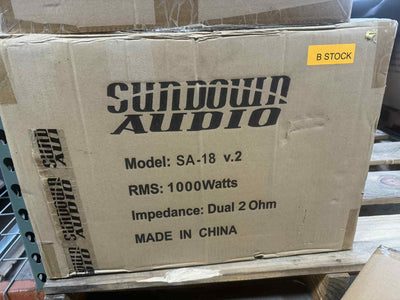
Why Matching Matters
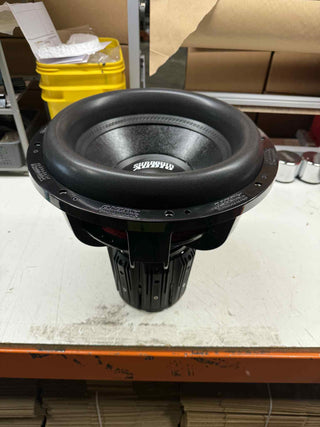
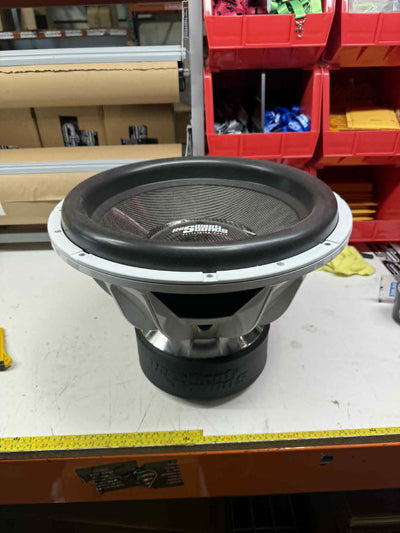
A subwoofer and an amplifier are a team. The amp sends power to the sub, and the sub turns that power into bass. If the amp sends too little power, you’ll be stuck turning the gain all the way up and distorting the signal — which damages subs over time. If the amp sends too much power, the sub’s voice coil can overheat and fail. The goal is to find a pair that operates comfortably in the same power range.
Step 1 — Match RMS Power Ratings
Every subwoofer and amplifier has two power numbers: peak and RMS. Ignore peak. Peak is a theoretical maximum that lasts only a fraction of a second. RMS (Root Mean Square) is the continuous power both components can handle in real use — that’s the number to match.
The Safe Zone Rule
- Amplifier RMS output should be 75%–150% of the subwoofer’s RMS power handling.
- Example: A sub rated at 500W RMS pairs well with an amp that puts out 375W–750W RMS at the correct impedance.
- Staying within this range gives you headroom without risking damage from clipping or over-powering.
Always check the amp’s RMS output at the impedance your sub will present. Browse our car audio subwoofers and amplifiers to find options with clear RMS specs listed on every product page.
Step 2 — Understand Impedance (Ohms)
Impedance is measured in ohms (Ω) and describes how much electrical resistance the subwoofer presents to the amplifier. Most subs come in 2-ohm or 4-ohm versions, but dual voice coil (DVC) subs add more options because you can wire the coils in series or parallel.
Common Impedance Configurations
- Single Voice Coil (SVC) 4Ω — Simple wiring, one impedance option.
- Single Voice Coil (SVC) 2Ω — Lower impedance, amp typically produces more power.
- Dual Voice Coil (DVC) 4Ω — Wire in series = 8Ω; wire in parallel = 2Ω.
- Dual Voice Coil (DVC) 2Ω — Wire in series = 4Ω; wire in parallel = 1Ω.
Don’t Drop Too Low
Some amplifiers are stable at 1Ω; others are not. Running an amp below its stable impedance rating causes overheating and failure. Always confirm your amp’s minimum impedance rating before choosing a wiring configuration.
Step 3 — Check the Enclosure Type
- Sealed box — Tight, accurate bass. Good for music that needs punch without extreme loudness.
- Ported (vented) box — Louder overall, especially at specific low frequencies. Great for hip-hop, EDM, and heavy bass genres.
- Bandpass box — Very efficient at a narrow frequency range. Less versatile but very loud in its range.
Every subwoofer manufacturer recommends a specific box volume (in cubic feet) and port tuning frequency. Check the sub’s product page or spec sheet for the recommended enclosure specs.
Step 4 — Consider Sensitivity
Sensitivity (measured in dB at 1W/1m) tells you how loud a subwoofer gets per watt of power. A sub with a sensitivity of 90 dB will be noticeably louder than one rated 85 dB at the same power level. If you have a lower-powered amp, pair it with a higher-sensitivity sub to maximize output.
Quick-Match Checklist
- ✓ Amp RMS output is 75%–150% of sub RMS power handling at the target impedance.
- ✓ Sub impedance configuration is within the amp’s stable impedance range.
- ✓ Enclosure type and volume match the sub manufacturer’s recommendations.
- ✓ Amplifier has a low-pass crossover to filter out frequencies above ~80–120 Hz.
- ✓ Gain is set by ear or with a multimeter — not cranked to max.
Not Sure Where to Start?
If you’re not sure which sub and amp combination works for your vehicle and goals, we’re here to help. Contact Us for a Free Recommendation →