What Is a Monoblock Amplifier?
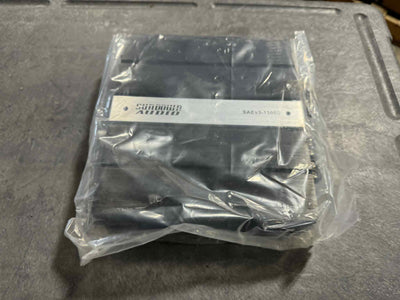
A monoblock amplifier has a single output channel. It sends all of its power to one destination — typically a subwoofer or a pair of subs wired together. Because 100% of the amp’s circuitry is dedicated to that one channel, monoblock amps can deliver very high continuous power at low impedances.
Monoblock Amplifier Strengths
- High RMS output — Built to sustain high wattage continuously, which is what subwoofers need.
- Low-impedance stability — Many monoblocks are stable at 1Ω or 2Ω.
- Class D efficiency — Runs cool and draws less current for the power produced.
- Simple crossover settings — Built-in low-pass crossover dials in only the bass frequencies.
When to Choose a Monoblock
- You are powering one or more subwoofers.
- You want maximum bass output from a dedicated channel.
- You already have (or plan to add) a separate amp for your speakers.
- You’re building a competition-style or high-SPL system.
What Is a Multi-Channel Amplifier?
A multi-channel amplifier has two, four, or five output channels that can power multiple speakers independently. Common configurations include 2-channel (stereo), 4-channel (front and rear speakers or bridged to sub), and 5-channel (four speakers plus one sub channel).
Multi-Channel Amplifier Strengths
- Versatility — One amp can power multiple parts of the system.
- Space savings — One unit instead of two or three separate amps.
- Simpler wiring — Fewer power and ground runs needed.
- Cost-effective — Often the most budget-friendly way to upgrade an entire system at once.
When to Choose a Multi-Channel Amp
- You want to upgrade both speakers and subwoofer with one purchase.
- You have limited trunk or under-seat space.
- You’re building a complete entry-level or intermediate system.
Bridging: Getting Mono Power from a Stereo Amp
Many 2-channel and 4-channel amps can be bridged — combining two channels into one higher-powered mono output. Bridging doubles the impedance the amp “sees,” so always confirm your amp’s bridged power output and minimum bridged impedance rating before wiring this way.
Class A/B vs. Class D
- Class A/B — Traditional topology, excellent sound quality for mid and high frequencies. Runs warmer and is slightly less efficient than Class D.
- Class D — Highly efficient, runs cool, standard for monoblock subwoofer amps.
- Class A/B + Class D (5-channel) — A/B for speaker channels, Class D for the sub channel.
Side-by-Side Comparison
| Feature | Monoblock | Multi-Channel |
|---|---|---|
| Best for | Subwoofers | Speakers & subs |
| Output channels | 1 | 2, 4, or 5 |
| Typical class | Class D | Class A/B or A/B+D |
| Low-impedance stability | Often 1Ω–2Ω | Typically 4Ω (2Ω bridged) |
| Space required | Moderate–large | Compact to moderate |
| Wiring complexity | Simple (bass only) | Moderate (multiple runs) |
Can I Use Both?
Absolutely. A common setup is a 4-channel amp powering the front and rear speakers, plus a separate monoblock amp dedicated to a subwoofer. See our Amp Wiring Kit Size Guide for help planning the wiring side.
Not Sure Which Type Fits Your Build?
Contact Us for Amplifier Advice →